Baden-Württemberg (Germany)
photographs from
SCHWÄBISCHE ROMANIK
Baukunst und Plastik im württembergischen Raum,
by Emil BOCK. 1979, Stuttgart
Swabia (original home of the Suevi) is the closest part of Germany
to France,
and is really a Romanesque spill-over zone, like Portugal, Ireland,
Scotland or Switzerland.

The first two photographs below may well be female exhibitionists.
The third is evidently a representation of Luxuria with luxurious braids.

Brackenheim

Erlach

Forchtenberg, tympanum.

This figure at Hemmensdorf is a tongue-sticking (?) male
whose genitals have been interfered with.
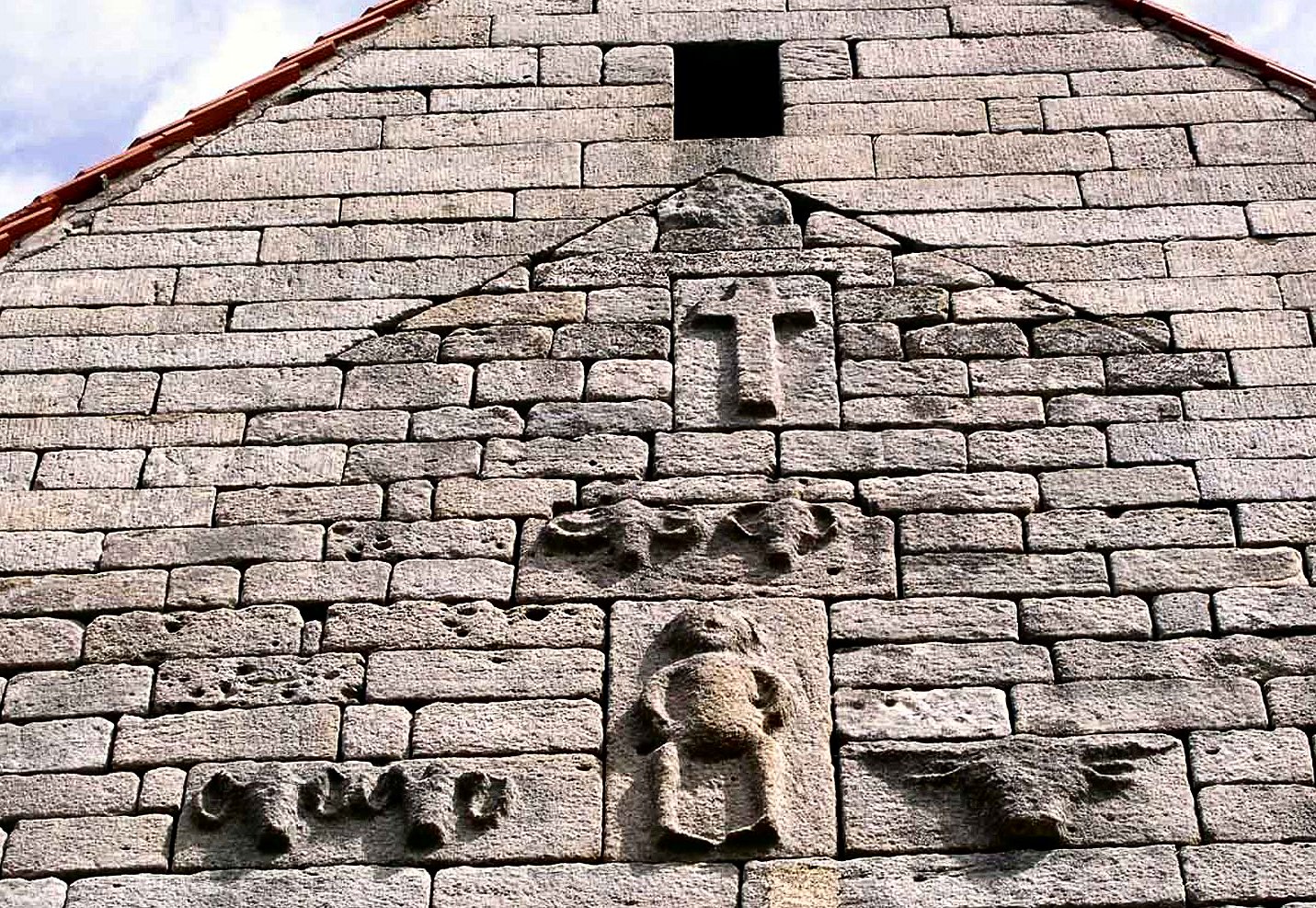
Belsen:
note the in-turned feet reminiscent of some post-Romanesque exhibitionists.
The animal heads surrounding this non-exhibitionist are another curiosity.
(This photo is not from Bock's book.)

The figure at Niederstetten seems also to be a non-exhibitionist
female.
Just for fun I append this splendid carving at Tübingen:
the sun praying ? (orans)

|
Pagan
gods or mediæval imagery?
The stone reliefs on the west gable of the chapel at Belsen. Apart from the famous "sun-hole", which, before the sacristy was added, directed the light of the rising sun into the archway of the entrance portal at the equinox, the west facade, with its enigmatic stone reliefs, has attracted the interest of experts and amateur researchers for centuries. This group of sculptures—a human figure surrounded by animal heads—is difficult to interpret, not least because of its severe weathering, and has been subject to countless interpretations in the past, making the chapel widely known. The first known account of the Belsen church dates from 1678. The Tübingen theologian Johann Adam Osiander, in his *Theologia moralis*, also mentioned the chapel when discussing the first commandment: “Near Tübingen, by the village of Mössingen, one can still see a temple on a hill where the devil was once worshipped. I saw a human-like figure with the form of him above the portal itself, sitting with legs spread on a tripod, and all around were the severed heads of the calves and cattle that were sacrificed. The place is called Belsen, and if our assumption is correct, this corresponds to the word Beelsamen, who was the sun god of the Phoenicians.” The name of the alleged sun god Beelsamen, who could be equated with the devil via the Beelzebub of the Bible (e.g., Matthew 12:24), came from the Church Father Eusebius of Cæsarea. The interpretation as a pagan cult site—of Celtic or Roman origin—subsequently shaped the perception of the Belsen Chapel. It was only in the course of the 19th century that the realization gradually took hold that it was a Christian church. However, even recently, a Roman origin for the stone reliefs was considered possible. According to current research, though, they too must be understood within the context of medieval iconography. Even after the Christian origin of the church building was acknowledged, it was still assumed that it had been built on the site of a pre-Christian sanctuary. Given the special atmosphere of the place, one might intuitively consider this a possibility. During Duncker's excavation, remnants of interlocking tiles were unearthed, which he believed to be Roman and which led him to think of a Roman temple complex or a Roman villa. A Roman settlement is considered certain in the Steinbreite area a few hundred meters southeast of the church. During the excavation in 1960, apart from further possibly Roman remnants of interlocking tiles, no evidence of a Roman predecessor building could be found, so that archaeological proof is still pending. Rendered from original German by Google Translate. |