A broken limestone carving, 32 centimetres high, weighing 75 kg/
allegedly from somewhere in the Côte d'Or.
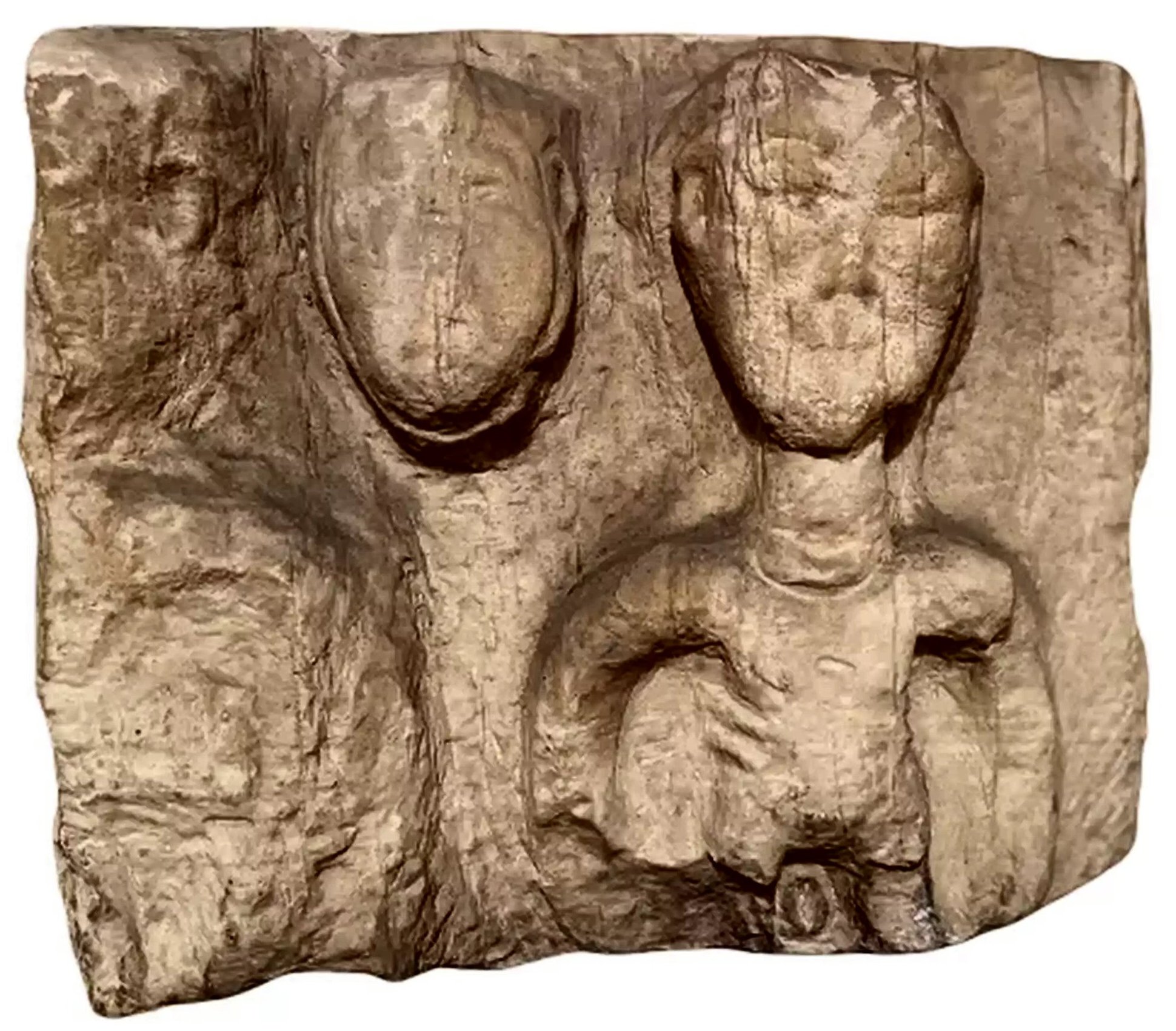
« An important bas-relief depicting
three figures, carved from a reworked block
possibly re-used in a Merovingian or pre-Romanesque building.
The figure on the right is thus a precursor to the Sheela-na- Gig
and the two-tailed
mermaids of the Romanesque period.
Her arms and legs are joined, and a vulva is visible in the crotch, suggesting
a fertility cult.

« Its attribution to the Second Iron Age
is confirmed by the presence of a torque,
the modelling of the torso and the hairstyle of the main figure (resembling
the figures on the Gundestrup
cauldron).
The three figures are also reminiscent of the Gaulish Matrones,
often depicted in triads. »
Apart from being unprovenanced, this remarkable sculpture,
now in my care,
presents a problem between its legs :
the vulva & clitoris are suspiciously well-defined,
which could mean that it has at least been worked on
at some time later than the rest of the carving.
As for provenance, there is only hearsay.
It is deeper than it is high, so it was obviously made to
be inserted
into the wall of a building, possibly in pre-Roman Gaul.
The survival of the vulva is something of a miracle
even if it were carved several hundred years later.

There are well-known remains of the late Merovingian priory of Saint-Vivant-de-Vergy
at Curtil-Vergy, not far from Dijon.
Another famous Merovingian site in Burgundy (but not in the Côte
d'Or) is at Luxueil-les-Bains,
which was founded by the Irish Saint Columbanus
at the end of the sixth century...
|
Matière : Pierre calcaire Dimensions : H 32cm - L 37cm - P 26cm Époque : 2ème-1er siècle avant JC.
Important bas-relief
représentant 3 personnages, bloc retaillé L'attribution
au deuxième age du fer est confirmée par la présence
d'un torque, |

Killinaboy church, county Clare, Ireland:
the first exhibitionist that I ever saw,
in 1971, with my mother.
The figure stands above the doorway.
Its ribs are very evident, which is not common, especiallynot in Romanesque
figures<
apart from some depictions of Luxuria,
notably at Moissac.
Other good Irish examples of emaciation are at Tullaroan.
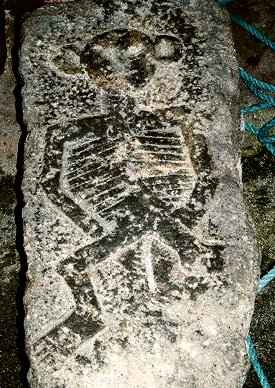
Tullavin,

and Dunnaman.

This figure is at St-Vivien-de-Médoc, close to where boats sailed to and from Ireland.

Other exhibitionists displaying ribs are at Balleen
in county Kilkenny and Llandrindod
Wells in Wales,
plus the male at Cheb in western Bohemia, Czech Republic.

See also Cavan, Clomantagh and Cullahill